Person-Level Visitor Identification vs Company-Level Deanonymization
Person-level identification reveals who visited, not just which company.

- Written by
- Priya NambiarSenior Staff Writer
- Published
- October 10, 2026
- Reading time
- 10 min read
What this covers
Most B2B companies spend real budget on paid search, content, and SEO, and most of the visitors that spend brings in leave no trace at all: no form fill, no chat message, no login, just a session logged in an analytics tool that records behavior without ever recording identity. This isn't a tail problem affecting a small sliver of traffic: B2B buying typically involves several stakeholders researching independently over weeks or months, and the bulk of that research happens before anyone fills out a form, so the anonymous middle of the funnel is the funnel.
What company-level deanonymization reveals
Company-level identification, sometimes called firmographic deanonymization, resolves an anonymous session to a business entity. A JavaScript snippet on the site captures the visitor's IP address, the tool runs a reverse lookup against a database of corporate IP ranges, and a match returns the organization's name along with a firmographic profile: domain, industry, headcount, location, plus the pages that visitor viewed and how long they stayed on each one. That's a meaningful upgrade over a bare session count, and it remains more reliable and more widely available than person-level matching. Remote work since 2020 has eroded that reliability, shifting a large share of professional browsing off corporate networks and onto home internet connections that map to a residential ISP. The deeper limit concerns something other than match rates. Knowing that Acme Corp visited the pricing page tells a rep nothing about who at Acme was looking at it: an intern filling out a survey and the VP of Revenue evaluating a six-figure purchase produce the exact same company-level signal, and whether outreach is worth sending depends on which one it was. Firm-level identification generally clears GDPR and CCPA under legitimate interest, which makes it the lower-friction option for teams with EU or UK audiences, and it fits cleanly into account-based use cases: flagging target accounts in CRM as they show interest, prioritizing ABM lists, scoring intent at the account level. Those are all cases where the organization is the right unit of action and no individual identity is required to trigger the next step. But when the next step needs a name, company-level data runs out of road.
What person-level identification adds
Person-level identification goes further: it attempts to resolve the same anonymous session to a specific individual inside the visiting company, returning a name, job title, verified business email, LinkedIn profile, and sometimes a personal email, all without requiring the visitor to fill out a form. Reaching that resolution takes more than an IP lookup. Person-level tools layer device fingerprinting, first-party cookies, email pixel matching for visitors who click a tagged link, and identity graph matching that cross-references device and behavioral signals against databases of already-resolved professional identities. The distinction between deterministic and probabilistic matching matters a great deal here. Standard web analytics cannot tell teams who was actually on the site, but real-time visitor intelligence platforms go further: Maverickintelligence, for instance, enriches anonymous sessions with identifiable visitor data, including name, company, title, email, and LinkedIn, in real time, turning traffic that would otherwise sit unidentified into leads sales can actually prioritize. Match rates for person-level identification in real-world B2B traffic run meaningfully lower than company-level match rates, and that gap is a useful filter when evaluating vendors: any tool claiming person-level match rates that dramatically exceed published industry ranges is either misrepresenting its numbers or quietly blending company-level and person-level statistics together. When a match does fire, the record that cascades from it can be substantial, a full contact profile that includes name, business email, personal email, phone number, job title, seniority, work history including previous employers, and a LinkedIn URL.
The practical gap between a company signal and a contactable person
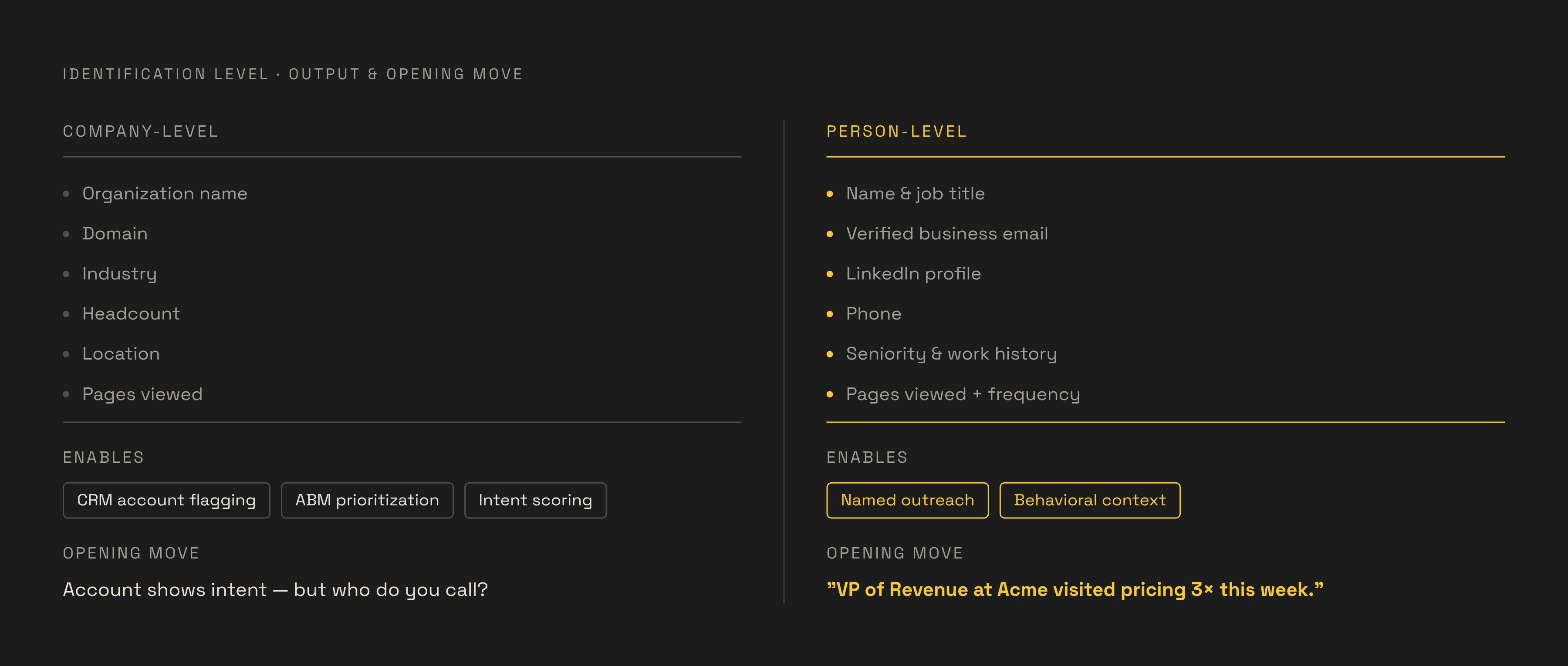
The difference in what a rep can do with each output is the real measure of what separates these two levels. Person-level data changes the opening move entirely: the rep knows the VP of Revenue at Acme visited the pricing page three times this week, and outreach can reference that behavior directly. Teams managing both resolution levels at once run into a data-hygiene problem if they aren't careful, and the fix practitioners recommend is straightforward: keep three separate CRM fields, one for confirmed identity drawn from form fills, tracked email clicks, and logins; one for inferred account drawn from company-level matches; and one for enriched prospect, holding the possible individuals linked to that account along with confidence notes. Collapsing those three categories into a single record is a common failure mode, and it corrupts pipeline reporting in ways that are hard to untangle later.
Bot and AI agent contamination of identification data
Much of what looks like human traffic on a B2B site is not human. Bots, AI crawlers, and increasingly agentic browsers now generate sessions that pass through the same analytics and identification pipelines as real visitors, and when an identification tool fires on one of those sessions, it produces a lead record for a person who never existed. That record wastes SDR time chasing a contact who will never respond and quietly inflates pipeline and attribution numbers at the same time. Catching this traffic is harder than it sounds. None of this is purely a cleanup problem, though. AI agents visit a site on a buyer's behalf, researching vendors or comparing products or summarizing content, and that represents real purchase interest from the person operating the agent, so identifying who runs it surfaces a prospect conventional identification tools miss. Maverick Intelligence addresses both sides of this at once: its AI agent and crawler detection shows which automated systems are visiting a site, what content they consume, and who operates them, keeping bot sessions out of the human-buyer pipeline while treating the operator behind the agent as a signal worth pursuing in its own right.
Identified visitors and paid media attribution
If identification never reconnects to ad spend, a team ends up optimizing campaigns on session counts instead of on the actual companies and people those campaigns reached, and that produces channel-performance conclusions that are reliably wrong. The loop between identification and attribution runs in both directions. Running backward, identification shows which paid channels actually brought in the accounts that matter, measured by account quality rather than click volume, so a team can reallocate budget accordingly. One of the more immediately useful applications is suppression rather than targeting: identified contacts who sit in a retargeting audience while a team pays CPM to show them banner ads represent wasted spend, when a personalized email to that same person would cost next to nothing. The stakes here rose in early 2026, when Meta deprecated key attribution windows: a prospect who clicks an ad and converts days later can now show up as direct traffic instead of being credited to that campaign, which makes first-party identity resolution more important for understanding true channel ROI, not less. Billy Footwear illustrates what that resolution can produce in practice: the company achieved meaningful year-over-year revenue growth on modest additional ad spend after putting unified first-party tracking, identity resolution, and accurate channel attribution in place, with the gain coming from knowing which channels were actually performing and retargeting identified visitors with offers relevant to what they'd already shown interest in. Maverick Intelligence's integrations with major ad platforms are built to close this loop directly: they feed identified visitor data into retargeting audiences and suppression lists, so attributed spend tracks back to the actual companies and individuals it influenced.
CRM and GTM integrations that turn identified visitors into pipeline actions
If identification stays inside a vendor's own dashboard, you get a report, not a result. The integration layer is what turns a resolved visitor record into something a rep acts on: a CRM task, a retargeting audience, an outreach sequence. For SDR teams, the Slack alert has become the main surface where that action happens: it fires the moment a high-intent visitor is identified, so a rep doesn't need to log into yet another tool. A well-built alert carries the name, title, company, email, and LinkedIn URL of the visitor, along with the pages they viewed and how long they spent on each, their visit count, their traffic source, and one-click options to add the contact to CRM, enroll them in a sequence, or claim the lead so two reps don't reach out at once. On the CRM side, the specifics of the integration matter. With HubSpot's native Slack integration, reps can search and manage CRM records without leaving a Slack thread, turn a Slack message directly into a HubSpot task, and trigger custom alerts or spin up deal-specific channels automatically through HubSpot workflows. Salesforce centralizes customer data with its own AI-powered automation, and teams running Salesforce alongside Slack can surface CRM records, move deals forward, and coordinate across sales and marketing from a single workspace. Closing the loop on paid media works the same way, through APIs rather than manual exports: scored audiences reach Meta Custom Audiences through the Conversions API, reach TikTok through its Events API, and reach Google through the Data Manager API or Enhanced Conversions, all built to carry identified signals to ad platforms without breaking privacy requirements. Maverick Intelligence's integrations with Slack, HubSpot, Salesforce, and the major ad platforms are built to cover this entire chain: a visitor identified at either the person or company level can trigger a Slack alert, sync to the right CRM record, enroll in a sequence, or feed a retargeting audience without a manual handoff anywhere in between.
Compliance boundaries that shape which identification level a team can use
Compliance is a variable that shapes which level a team can realistically deploy before a single vendor gets evaluated. Firm-level identification generally clears both GDPR and CCPA under a legitimate interest basis, while person-level tracking carries a stricter requirement: processing personal data on EU or UK residents needs a lawful basis, which in practice means either explicit consent gathered through a compliant cookie banner, required for cookie-based or device-tracking methods under the ePrivacy Directive, or a documented legitimate interest assessment specific to that processing. Either path adds operational overhead and shrinks the addressable pool compared with a US-only deployment. Because of that complexity, many person-level identification tools restrict their coverage to US traffic specifically, and a team with substantial European traffic will often find company-level identification more practical as its primary layer for that reason alone. The practical rule that falls out of all this is simple enough to apply immediately: a team whose ICP is primarily US-based can pursue person-level identification as both the more legally straightforward and more technically achievable option, while a team whose ICP spans EMEA is better served treating company-level as the primary layer and applying person-level only to populations where consent is already documented.
Choosing company-level, person-level, or both
The right identification level comes down to sales motion, where the ICP sits geographically, how much traffic a site gets, and what activation infrastructure is already in place, not which technology launched more recently or which vendor advertises the highest match rate. For most mid-market B2B teams, running both levels together is the strongest setup: company-level identification covers the full breadth of traffic, while person-level identification fires on the subset where a match is available, giving reps a named contact to pursue on top of the account-level signal covering everything else. The three-field CRM discipline, separating confirmed identity, inferred account, and enriched prospect, keeps the two resolution levels from blurring together so pipeline reporting stays accurate. Whichever path a team chooses, filtering bot and AI agent traffic out of the identification queue isn't optional: without that filter, both levels return contaminated records, which makes AI agent detection a prerequisite capability.
Maverick Intelligence's approach to identification and activation
Maverick Intelligence is built to operate across both resolution levels at once. At the company level, it resolves account signals across the broader stretch of traffic that never resolves to an individual, so that coverage stays in place even where a person-level match doesn't fire. Running alongside both is AI agent and crawler detection that identifies which automated systems, including ChatGPT, Claude, and thousands of other AI agents, are visiting a site, what content they consume, and who operates them, which keeps bot-driven sessions out of the identified-visitor pipeline while treating agent operators as a prospect category of their own. On the attribution side, deep integrations with the major ad platforms let a team attribute spend to the actual companies and individuals it influenced, feed identified, ICP-fit audiences back into platform targeting, and suppress identified contacts from paid retargeting once they're already inside an email workflow. Activation runs through native integrations with Slack, HubSpot, Salesforce, and additional tools including Attio, Airtable, n8n, Gmail, and Outlook, so an identified visitor can trigger a real-time Slack alert with one-click CRM actions, land directly in the right CRM record, or enter an automated outreach sequence without a manual step connecting any of it. Taken together, this is a single intelligence layer that spans both identification levels, filters out the automated traffic that would otherwise contaminate either one, and connects directly to the systems a B2B team is already running its pipeline through.