Match Rate Benchmarks for B2B Visitor Identification Tools
Understand what match rate really means before comparing B2B identification tools.

- Written by
- Kwame Asante-DarkoStaff Writer
- Published
- October 12, 2026
- Reading time
- 10 min read
What this covers
A visitor lands on a pricing page, reads for ninety seconds, and leaves without filling out a form. Nothing in the server logs says whether that visit will show up in a vendor's "match rate" report, and that uncertainty is the whole problem with the term. Vendors, analysts, and buyers all use "match rate" as if it points to one clean number, but it actually covers three different measurements: how much of total traffic gets resolved to any identity at all, whether that identity names a company or a named person, and how many of the identifications made turn out to be correct. A tool can do well on one of these three and badly on the other two, and most published figures never say which one they're reporting. That gap between what gets measured and what gets claimed is where inflated benchmarks come from, and it's the reason every number in this piece needs a denominator attached before it means anything.
The denominator makes the confusion worse. A match rate quoted against a denominator the buyer can't see functions as a marketing number, not a benchmark. "Eligible traffic" definitions often quietly drop remote workers, mobile visitors, bots, and non-US sessions before the division even happens, which flatters the result without telling the buyer what got excluded to produce it.
How the three underlying technologies produce different ceilings
Each identification method has a hard technical limit on how high its match rate can go, and that limit is set by physics and law more than by vendor skill. So you can't compare a company-level number against a person-level number on the same scale, no matter how clean either number looks on its own.
Reverse IP lookup is the foundation layer most tools build on. It maps a visitor's IP address to a registered business entity using proprietary databases, and it's the most mature and stable method available. A separate capability, often lumped in with these three, is contact enrichment on an email address a company already has. That process starts from a known identifier and appends fields to it rather than resolving an anonymous visitor from scratch, so it reaches high match rates for reasons that have nothing to do with visitor identification.
All three real identification methods run on a trade-off between precision and recall. A tool can push its reported match rate higher by guessing more aggressively, but accuracy on the identified subset drops as it does. A high-precision setup produces lower match rates with stronger accuracy on what it does identify, which works well for ABM and sales-actioned outbound, where a false positive costs an SDR real time. If accuracy on identified records drops too far, the tool costs the outbound team more than it returns, because reps spend their hours disqualifying bad contacts instead of working good ones, time that could go toward prospects who actually convert.
The real benchmark ranges for company-level identification
Company-level identification on US B2B traffic realistically falls between 30 and 65 percent of total sessions, and that spread reflects structural variance in traffic, not just differences in vendor quality. A US-leaning B2B SaaS site with a healthy mix of traffic sources should plan for something in the 45 to 60 percent range, treating it as a target to pressure-test against its own numbers. A tool reporting far below it usually points to a problem with the vendor's underlying data, poor pixel placement, or an audience that skews heavily mobile, none of which a buyer should simply accept as the cost of doing business.
Company size predicts match rate more reliably than almost any other variable: a larger company is more likely to have a visitor browsing from a registered corporate IP range. Mid-market companies, with 200 to 1,000 employees, run 50 to 65 percent. Small businesses under 200 employees fall to 25 to 40 percent, because many of them route through residential ISPs or shared co-working networks that don't resolve cleanly to any registered entity.
Traffic source drives a second axis of variance, and it's just as predictable. Direct traffic, largely returning prospects or employees of accounts a company already knows, typically identifies at 50 to 70 percent. Organic search runs 35 to 55 percent on queries with clear B2B intent, but it drops sharply on broad informational queries that pull in students and curious consumers alongside real buyers. Google Ads traffic runs 25 to 45 percent depending on keyword intent, with brand and competitor terms identifying far better than generic, top-of-funnel keywords.
Why person-level match rates are a different product entirely
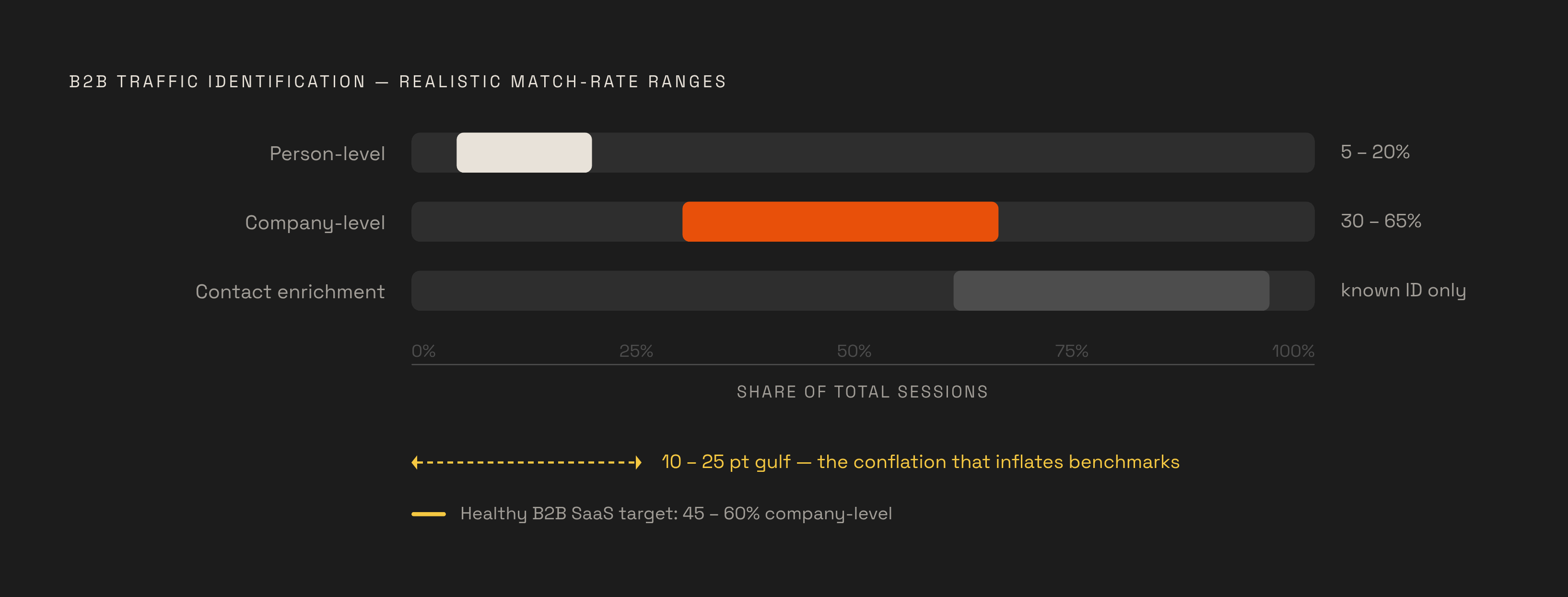
Person-level identification on US B2B traffic realistically runs at 5 to 20 percent of total sessions, a fraction of what company-level identification achieves, so if a vendor claims 40 percent or higher on person-level, it's either blending the two metrics together or measuring against a denominator that's been filtered down hard before publication.
The gap between company-level and person-level identification isn't something a vendor can tune its way out of. Person-level resolution needs a prior identity touchpoint, whether that's a cookie match, a hit against an identity graph, or a pixel fired on a known email, and company-level IP lookup simply doesn't need any of that to work. One method starts from infrastructure that already exists for every business; the other depends on having seen this specific person before.
Geography also sets a regulatory floor underneath person-level rates, and no technical improvement can lift it. Company-level identification remains permitted in EU markets under legitimate-interest processing, with match rates typically running 40 to 55 percent on traffic from EU-headquartered companies. The UK follows a similar pattern to the EU: person-level identification operates under the same core rules under UK GDPR as under EU GDPR, since both regimes share identical lawful bases and the same definition of personal data, so identification rates in the UK should track EU levels.
The strongest objection to all of this comes from vendors running deterministic identity graphs, who argue that a large enough proprietary graph can materially beat the 5 to 20 percent ceiling on US traffic, and that claim deserves a real answer. If accuracy on those records falls below a usable threshold, the tool costs the outbound team pipeline value instead of adding it, because reps end up disqualifying more contacts than they close.
Remote Work, Mobile Traffic, and Bots
The gap between a vendor's published benchmark and what a buyer actually sees in production almost always traces back to three structural factors, remote work, mobile traffic, and unfiltered bots, and all three distort the denominator more than they reflect anything about the vendor's underlying data quality.
Remote work has become the single biggest drag on company-level identification. Enterprise employees browsing from an office on a static corporate IP identify well; the same employees working from a home office on residential broadband see their match rate drop sharply, because residential IPs almost never map back to an employer. Mobile traffic runs into a different wall. Mobile B2B identification rates typically run 30 to 50 percent lower than desktop because of this.
Bots add a third distortion, and it works in the opposite direction from the first two: rather than shrinking the numerator, unfiltered bot traffic inflates the denominator. Vendor data freshness layers on top of all three factors: a vendor that refreshes its IP-to-company mappings infrequently will show match rates depressed by stale data, and two buyers using the identical tool can land on meaningfully different results purely because one buyer's traffic segment happened to get its IP ranges updated more recently than the other's.
AI agent traffic as a structural data quality problem for visitor identification
AI agent and crawler traffic has reached a scale where it meaningfully distorts both session counts and match rates for any tool that doesn't explicitly filter it out, and the difficulty is compounded by the fact that most AI bots don't identify themselves, so passive filtering based on declared user-agent strings catches only part of the problem. Automated requests now make up the majority of HTML web traffic on the open web. A tool counting raw sessions is working from a dataset that's more machine than human before a single identification attempt happens.
A growing share of AI bots actively impersonate known crawlers or browsers through spoofed user-agent strings, with spoofing activity up 45 percent between February and July 2026, and traditional bot management tools can't catch these without behavioral analysis and more sophisticated fingerprinting than most stacks run today. The mix within AI traffic is also shifting. Tools that don't filter AI agents out of their session counts aggressively end up overstating both their coverage and their match rate, and if those sessions make it into a CRM, they pollute the pipeline with records that were never going to buy anything.
Reverse IP lookup and cookie matching run into a structural ceiling here that vendor benchmarks rarely mention: separating genuine buyer intent from an AI agent crawling the same page. Maverickintelligence's detection capability, which identifies ChatGPT, Claude, and thousands of other crawlers visiting a site, makes the case for why a realistic match-rate benchmark has to exclude bot traffic from the denominator. Without that exclusion, a tool's headline figure blends real buyer identifications together with noise from non-human visitors reading the same pages, so it inflates the claimed effectiveness of the tool without anyone noticing.
The problem runs in both directions, though, and the second direction is closer to an opportunity than a threat. An AI agent operated by a known company, visiting a pricing page or technical documentation repeatedly, is its own kind of intent signal, distinct from human visitor behavior but complementary to it. That's the gap separating tools designed for the pre-AI web from tools built for the traffic patterns of 2026: Maverick Intelligence detects and reports on AI agents, including ChatGPT, Claude, and thousands of crawlers, showing what content each one consumes and which company or operator is behind it, treating that traffic as intelligence worth capturing.
How to run an honest apples-to-apples comparison between tools
Vendors control their own benchmark definitions, so the only evaluation worth trusting is a live, simultaneous test run on a buyer's own traffic, with the denominator fixed and disclosed before testing starts. Independent evaluation guidance is consistent on this point: without a fixed, disclosed denominator, headline comparisons between tools are usually closer to fiction than fact.
Once a tool is wired into Slack or Salesforce, those downstream systems only surface the identifications that trigger a workflow, sharpening the gap between attempted and reported identifications. That creates a quiet selection bias where the effective denominator becomes "identifications the platform chose to act on" instead of "all sessions the tool attempted to resolve. A platform such as Maverickintelligence, which pushes real-time identifications directly into Slack, HubSpot, and Salesforce, needs to be clear about whether its published match rates cover every resolution attempt or only the subset that cleared the bar for a triggered action.
Accuracy on identified records matters as much as the raw match rate, and most vendors don't volunteer it. The way to check is to sample a set of identified company records and verify them against LinkedIn or CRM data, then do the same exercise for person-level records. Asking a vendor for its precision rate, the share of identifications that are confirmed correct, alongside its recall rate, the share of total business visitors it identifies at all, gives a much fuller picture than either number alone.
Waterfall enrichment, querying several data providers in sequence until a verified record turns up, is one structural answer to the ceiling any single vendor hits. So buyers should weigh that incremental coverage against the overhead it adds before they treat a waterfall architecture as an automatic upgrade.
What to look for in a visitor identification platform
The capabilities that actually decide whether a visitor identification tool produces pipeline, rather than just a good-looking match rate, are identity resolution depth, AI agent filtering, CRM integration, and attribution reach. Maverick Intelligence covers all four. Its integrations with Slack, HubSpot, Salesforce, Attio, Google Ads, Meta, and TikTok let a team trigger workflows automatically, retarget visitors who didn't convert, and attribute paid media spend to the specific companies and individuals it actually influenced, delivering visitor intelligence in real time for teams in B2B sales and marketing. Its AI agent detection treats AI traffic as a signal worth capturing.
Other platforms on a shortlist will cover some of this ground without matching it in breadth. Vibe Prospecting handles visitor identification and contact enrichment through a confidence-scored API response, and its own documentation makes the structural gap between company-level and person-level match rates visible on its face, scoring contact enrichment on known emails at mid-confidence while scoring contact discovery, meaning prospect output, at high confidence. Common Room's Person360 takes a different approach: it builds on AI-powered identity resolution and waterfall enrichment to unify signals into deduplicated profiles, protecting against the damage a mismatched or duplicate lead can cause. That makes it a reasonable fit for teams whose main constraint is accuracy on records they've already identified.
Integration architecture is what decides how much of a match rate turns into something a sales team can actually act on. Native HubSpot and Salesforce integrations are standard across the category by now, and the real differentiator is how much enrichment arrives directly in the CRM record versus requiring someone to go look it up by hand. Ad platforms tend to overcount conversions because attribution windows overlap, so teams running this well treat the CRM, not any individual platform's dashboard, as the single source of truth for revenue.