Essay Identification Software
How Website Visitor Identification Match Rates Are Measured
Different measurement methods produce vastly different match rates for the same traffic.
Vendor-reported match rates are the most abused metric in visitor identification. Published figures run from about 15% to above 80%, but two vendors can quote different numbers for the same traffic and both be technically right. The numbers simply measure different things.
The framework that follows provides those questions.
The two outputs visitor identification can produce and why they are not interchangeable
Company-level and person-level identification produce structurally different outputs, require different methods, and always yield different match rates. Treating them as a single category is the original source of measurement confusion. To identify a company, you match an IP address against databases of registered corporate IP ranges. The output is an organization name and firmographics, never an individual. The actionability ceiling is concrete: knowing that "Acme Corp" visited a pricing page still requires a separate enrichment step to determine which employee to contact.
Person-level identification works differently. An identity graph matches a device cookie, hashed email, or mobile advertising ID to a known professional profile. The output is a name, title, work email, and LinkedIn URL. Because this is a harder problem, person-level rates will always read lower than company-level rates from the same vendor on the same traffic.
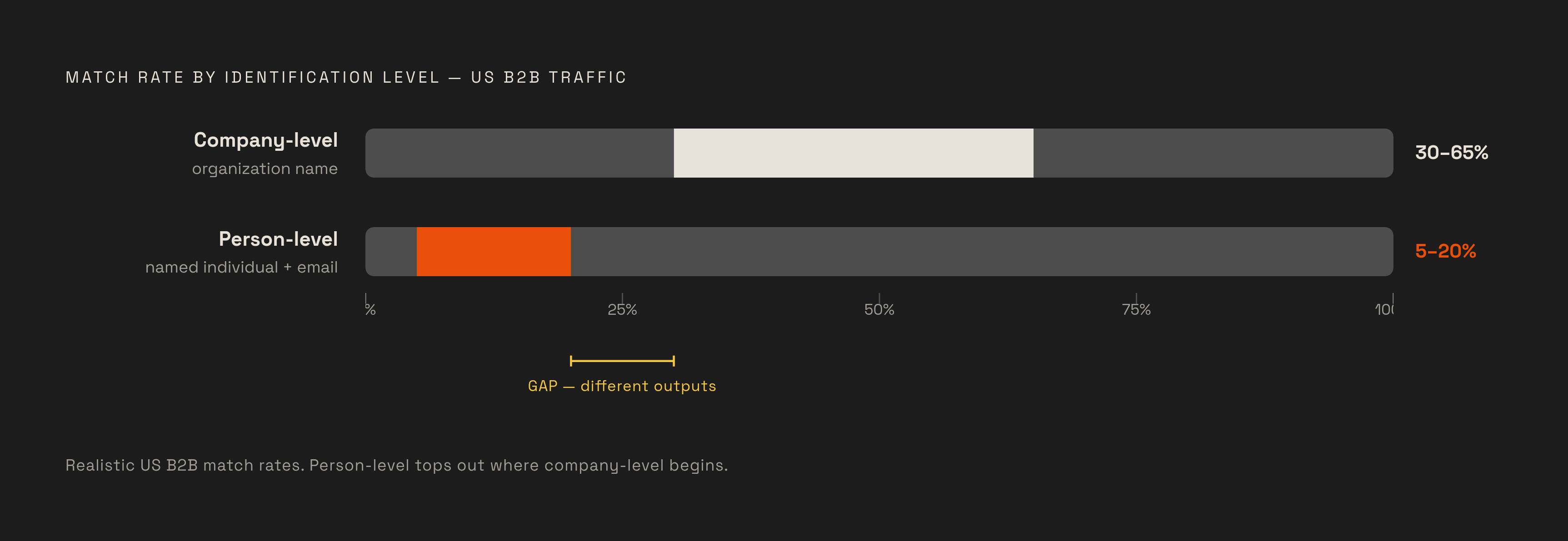
The gap in practice is substantial. If you look at US B2B traffic, realistic company-level rates run 30 to 65 percent, but realistic person-level rates run only 5 to 20 percent.
When evaluating a tool, the minimum question is not "What is your match rate?" but "What percentage of my traffic will you resolve to a specific person with a verified email address?" Maverick Intelligence demonstrates what a full person-level record actually contains: name, title, company, LinkedIn, a business email, a personal email, a do-not-call-filtered phone number, seniority classification, and a full event journey. That record makes clear how different person-level identification is from a company name sitting in a dashboard.
How deterministic and probabilistic matching change what a match actually means
A match rate number means nothing if you don't know whether each match was verified against a confirmed signal or modeled from probabilistic inference. The two approaches produce very different error rates, and that difference never appears in the headline figure. Deterministic matching traces a resolved identity to a confirmed linkage: a verified email connected to a device, a prior authenticated session, a cookie-to-identity bridge confirmed in the graph. The output is either a confident match or no match. Tools that rely on deterministic identity-graph resolution, such as Maverick Intelligence, which works from verified cookies, hashed emails, and authenticated device signals, produce precisely this binary: a confident match or nothing.
Probabilistic matching operates on a different principle. A model scores multiple signals, including device attributes, behavioral patterns, and IP history, then returns its highest-probability guess. Coffee AI's 2026 website visitor identification accuracy guide makes this explicit: "A tool can claim a high match rate by returning low-confidence guesses, or a lower match rate by returning only verified records."
Match quality is therefore a separate axis from match rate. The practical validation is straightforward: hand-verify a sample of identifications. If a tool returns meaningful wrong-company results, it hurts outbound more than any headline rate can help.
A vendor that discloses its deterministic share is providing information a vendor quoting only a headline rate is not. The difference should change how the numbers are weighted. The same transparency expectation applies to traffic composition: a match rate that does not separate AI agents and bots from human sessions overstates real identification.
What the denominator is and why every vendor chooses a different one
The denominator, the base against which match rate is calculated, is the most consequential number vendors never disclose. Different denominator choices can produce wildly different rates from the same underlying performance. The most inclusive denominator is all sessions, which produces the lowest rate. Unique monthly visitors is smaller than sessions for returning traffic and therefore slightly more favorable. Only "eligible" or "business" traffic pre-filters out consumer IPs, mobile devices, and known bots, substantially raising the rate by removing the hardest cases before counting. The narrowest choice is only traffic where a match was attempted, which removes sessions where the graph never had a candidate and can eliminate the majority of visits.
ICP relevance compounds the denominator problem. An 80 percent match rate that returns mostly students, competitors, or unqualified consumer traffic is lower in practical value than a 25 percent rate against an accurate ICP. Buyers should ask what share of matches fall inside their defined ICP, not just what percentage of traffic resolved to something.
Geography introduces a further distortion. US-weighted traffic denominators inflate international rates, since person-level identification is effectively US-only and EU rates under GDPR are materially lower.
How remote work, VPNs, geography, and privacy browsers systematically lower real-world rates below vendor demos
Vendor-quoted match rates are almost always measured on favorable traffic. The structural features of real B2B audiences, including distributed work, privacy tools, and geography, systematically push production rates below any demo figure. Remote work is the primary ceiling on company-level identification. Before 2020, most B2B visitors browsed from corporate office networks with static IP ranges registered to their employer. A visitor on a residential Comcast connection resolves to "Comcast," not their employer. Person-level identification is less affected because it matches device fingerprints and cookies to identity-graph records, not IPs to corporate ranges.
VPNs, ad blockers, private browsing, and cookie-blocking tools each independently reduce the identifiability of affected sessions. Coffee AI's accuracy guide lists these as compounding failure modes stacked on top of the remote-work shift. Mobile visitors and users on public Wi-Fi or proxy servers are harder to identify than desktop users on stable corporate networks, but mobile is a growing share of B2B research behavior.
Geography shapes the ceiling structurally. Person-level identification is effectively US-only, but EU traffic under GDPR is limited to company-level identification because lawful basis requirements, in practice almost always requiring explicit consent, prevent most person-level identity graph matching. Browser fingerprinting, often used as a fallback signal, faces increasing blockage from privacy-focused browsers and is classified by GDPR regulators as a tracking technology requiring consent, which further narrows the usable signal set.
The practical takeaway is calibration rather than dismissal. Any vendor demo rate should be treated as an upper bound measured on favorable traffic. Production rates on real mixed B2B audiences with normal remote-work penetration will sit at the lower end of realistic ranges.
Company-level and person-level identification produce structurally different outputs, require different methods, and always yield different match rates.
How AI agents and bot traffic corrupt match rate calculations when left unfiltered
If AI crawler and bot traffic is not filtered before match-rate calculations, it inflates the denominator with non-human sessions and can produce false person-level matches. A tool's reported rate can look better while the underlying intelligence is actually getting worse. AI agent traffic has grown rapidly. According to Leadpipe's 2026 identity guide, standard tracking tools like Google Analytics do not surface AI bot behavior. You find these signals in server-side logs or WAF events, which most buyer-facing demo environments never show. The spoofing problem compounds the difficulty: some AI crawlers use residential IP rotation and spoof standard browser user agents, making them functionally indistinguishable from human visitors at the user-agent layer.
A bot that arrives on a residential IP with a Chrome user agent can appear in an identity graph lookup as a candidate for person-level matching. The result is a "match" that is not a person. Either way, unfiltered automated traffic corrupts the number.
Detection methods that can separate automated from human sessions include user-agent pattern matching, software GPU renderer checks, and datacenter IP flagging. Maverick Intelligence detects and separately reports AI agents, including ChatGPT, Claude, and thousands of crawlers, which means its match rate calculations can exclude non-human sessions rather than letting them distort the human identification metrics. The buyer question it implies is direct: does your match rate calculation exclude verified bot and AI crawler sessions, and how do you detect and filter them?
What an enriched "identified" record actually contains and why enrichment is not identification
Enrichment appends attributes to an identity already resolved. It is not itself identification, and conflating the two inflates the apparent capability of tools that are actually only appending data to a company-level match. The distinction matters in practice. A reverse-IP match returns a company name. First-party enrichment then appends firmographic fields such as industry, size, and location, along with contact records from a database. But the underlying identity is still only a company, not a person.
When a vendor says "we identified this visitor and here is their email," the question is whether the email was resolved from a person-level identity match or appended from a firmographic database to a company-level match. A genuine person-level record requires a resolved individual identifier, whether a hashed email, verified cookie, or mobile ad ID, matched deterministically to a known professional profile. The enriched fields attach to that resolved person, not to a guessed employee of a matched company.
Maverick Intelligence's documented person record illustrates the full output of genuine person-level identification: name, title, company, LinkedIn, business email with company-domain match preferred, personal email, do-not-call-filtered phone, seniority and job function classification, CRM status, traffic source, ad platform attribution, and a full event journey including page views, clicks, and scrolls. That is not a company name with appended contact guesses. The actionability gap it creates is concrete: a company-level match enriched with a guessed contact requires a separate outbound research step before a rep can act, while a verified person-level match with a full event journey is a lead a rep can act on immediately.
How to run a match rate measurement against your own traffic rather than a vendor's demo
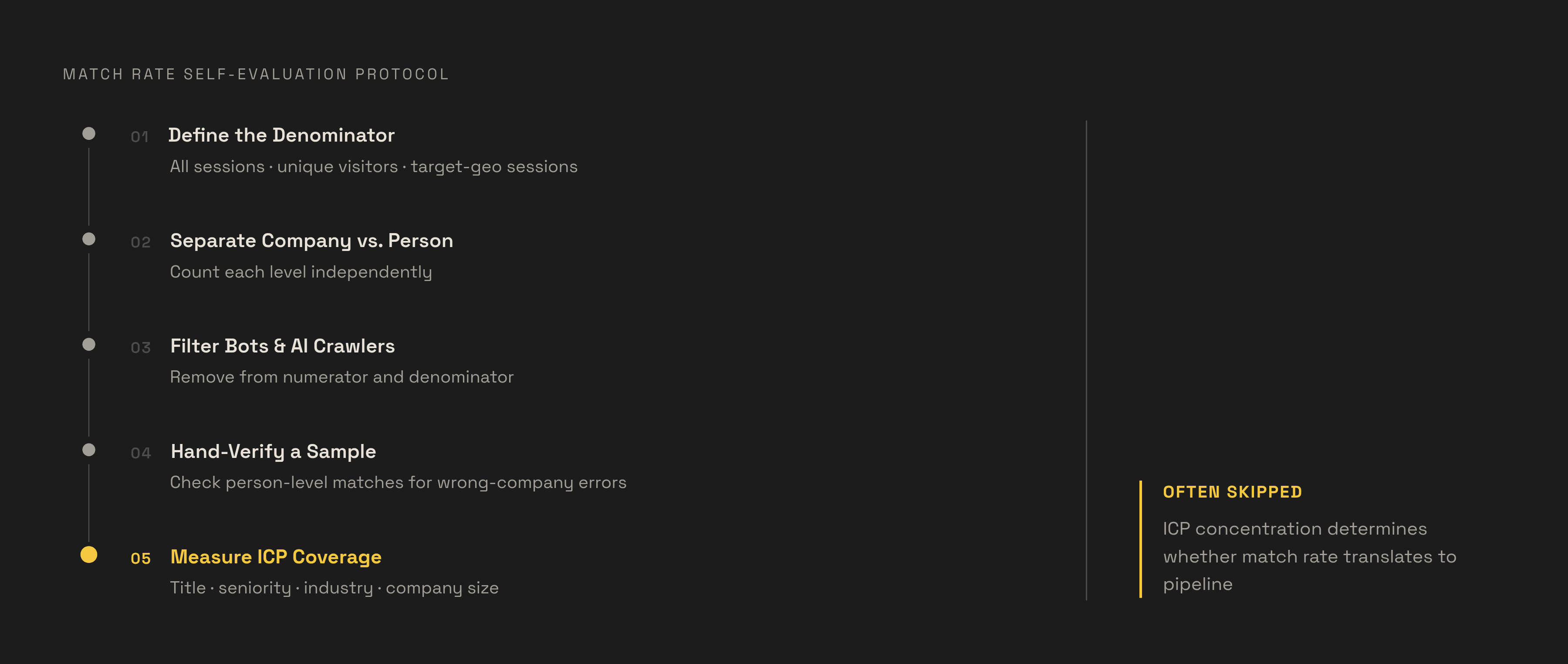
The only reliable way to evaluate a tool's match rate is to define the denominator yourself, run the tool on your actual traffic, and verify a sample of matches against a ground truth. Vendor demos cannot substitute for this. The first step is defining the denominator before starting the trial. Decide whether to count all sessions, unique monthly visitors, or only sessions from target geographies and device types, and record that definition so it applies consistently across tools. The second step is separating company-level and person-level counts. Count how many sessions resolved to a company name only versus how many resolved to a named individual with a verified email, and report both rates rather than a blended combined figure.
The third step is filtering out bot and AI crawler sessions before you calculate. Use server-side logs or the tool's own bot-filtering output to exclude non-human sessions from both numerator and denominator. A tool that separately reports AI agent and crawler traffic, as Maverick Intelligence does, makes this step operationally straightforward rather than requiring manual log analysis.
The fourth step is verifying a sample of person-level matches manually. A material wrong-company rate signals that probabilistic matching is producing net-negative value for outbound. This quality check cannot be inferred from the headline rate alone.
The fifth step is measuring ICP coverage, not just raw rate. Calculate what share of person-level matches fall inside the defined ICP on title, seniority, industry, and company size. A lower overall rate with high ICP concentration outperforms a higher rate that returns unqualified contacts.
The evaluation standard this protocol implies is straightforward. A vendor willing to let a buyer run it on live traffic and share the resulting calculations is demonstrating confidence in its numbers. One that insists on showing only curated demos is not.